What is Behavior?
Introducing the two cultures of behavioral sciences
Superscript numbers mark citations in the original text; the full bibliography lives in the thesis PDF.
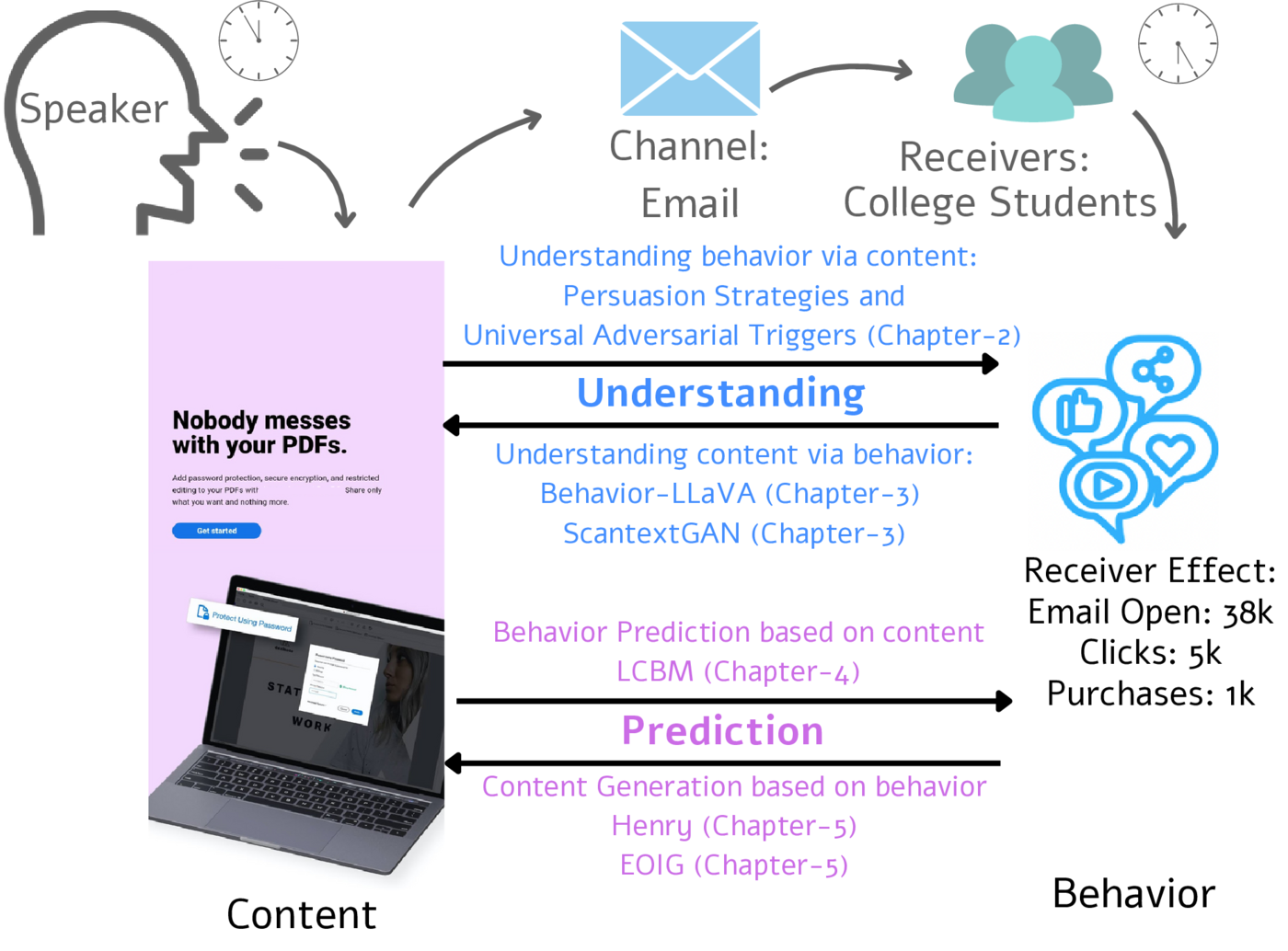
Behavior as a modality* occurs in the process of communication. Communication includes all of the procedures by which one mind may affect another1. This includes all forms of expression — words, gestures, speech, pictures, and musical sounds. Communication can be seen as being composed of seven modalities: the communicator, the message, the time of the message (or time of receipt), the channel, the receiver, the time of effect, and the effect.
* A modality is a medium through which information is conveyed; a multimodal distribution, similarly, is one with more than one peak. Behavior is treated here as one such medium — a channel of information in its own right, alongside text, image, and audio.
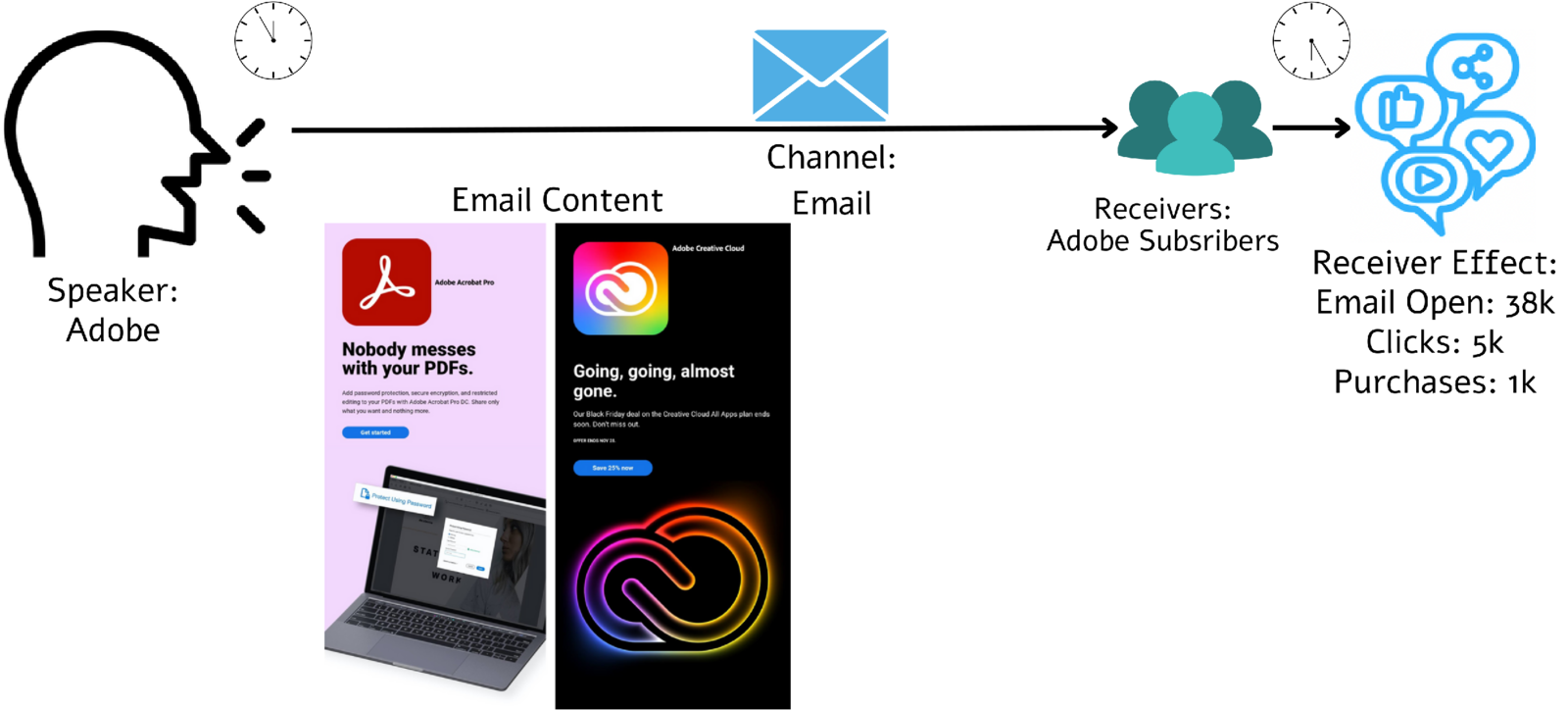
The seven modalities interact in different ways depending on the context. Four cases illustrate the range:
Mass communication — a speech
The communicator is an individual or organization; the channel is radio, television, or the internet; the effect is the audience's subsequent behavior. The communicator controls three factors — the message, the channel, and the timing. A politician speaking on "Artificial Intelligence" tailors the message to public radio versus a live rally, and a speech near Independence Day carries different themes than one at New Year's. In live delivery, the time of effect is simultaneous with the message.
Social media
Communication becomes asynchronous. The communicator still controls message, channel, and timing, but reach and effect are also shaped by the platform's algorithms. A company announcing a launch on Twitter crafts the message differently than in a live keynote, and posts during peak hours for visibility. A tweet can be shared and rediscovered over time, so the time of effect is no longer simultaneous with delivery.
Peer-to-peer
Two individuals exchange messages over a mutually agreed channel — WhatsApp, email, a phone call. Unlike mass communication, the sender does not choose the audience; the interaction happens only once both parties establish a connection. The effect is more controlled, but still depends on timing, the receiver's interpretation, the sender, and the channel.
Bidirectional exchange
A continuation of the peer-to-peer case where communicator and receiver swap roles each turn. The channel stays the same; the effect of one turn becomes the message of the next, its receiver becoming the next communicator — a conversation.
These modalities vary independently of each other and carry signals about one another2. The message carries information from communicator to receiver; behavior — the effect — carries information back from the receiver. This is often a continuous cycle, where behavior generated in one turn becomes the message of the next, forming a conversation.
Two cultures: explanation and prediction
Different fields of behavioral science deal with different parts of behavior, but two streams have emerged broadly: the explanation and the prediction of behavior3.
Historically, behavioral social scientists have sought explanations that provide interpretable causal mechanisms. Milgram's and Asch's experiments explained obedience to authority4. Cialdini identified six principles of persuasion — reciprocity, commitment, social proof, authority, liking, and scarcity — a framework that explains why certain messaging works5. In economics, Kahneman and Tversky's prospect theory explains decisions under uncertainty through biases like loss aversion6.
This approach of theorizing has worked remarkably well in the physical sciences, where data is plentiful and theories make unambiguous predictions. Newton's laws precisely predict planetary orbits, letting us calculate when Halley's comet returns — every 76 years. Einstein's relativity predicted the bending of light, confirmed during the 1919 solar eclipse. The periodic table predicted undiscovered elements; Maxwell's equations predicted radio waves decades before Hertz demonstrated them.
Cialdini's principles explain why an authority figure influences behavior — but they cannot predict, with Newton-like precision, whether a specific endorsement will lift sales by 15% or 50%.
Such theoretical success has not been replicated in predicting social outcomes7. Human behavior is far more complex and context-dependent than planetary motion. Studies repeatedly show that expert opinions fare no better than non-experts at predicting economic and political trends, societal change, or advertising success — and that non-expert predictions of behavior (which cascades spread, which images are memorable) are roughly as good as a coin toss8. Causal mechanisms still have their merits: they help human decision-makers make intuitive sense of a situation and choose the next action.
In parallel, the availability of behavioral data at scale has drawn machine learning into classically behavioral questions — persuasion strategies, information diffusion, and the predictability of behavior9. This prediction-oriented approach mirrors deep learning's success elsewhere: models classify images with superhuman accuracy (97.8% on ImageNet versus 94.9% for humans) without understanding why an image contains an object; language models achieve remarkable performance through pattern recognition; recommender systems predict preferences — Netflix's was estimated to save the company \$1 billion a year — without modeling the psychology behind them.
Within the prediction community, subfields have splintered: personalization optimizes the receiver for a message; recommendation chooses content for a receiver; effect-prediction forecasts click-through, cascades, sales, and memorability. Each factor of communication is studied in isolation, without relying on the underlying unity of the communication process. Some of the major problems studied across behavioral science:
Sender space
- Source optimization — who should send a message to a given audience.
Receiver space
- Personalization
- Customer segmentation
- Social network analysis
- Lookalike modeling
- Market surveys
- Identity stitching
- Behavior explanation
Content space
- Recommender systems
- A/B testing
- Customer targeting
- Propensity / engagement modeling
- Transsuasion & transcreation
- Search engine optimization
- Performant content generation
- Argument mining · persuasion strategies
Channel space
- Channel optimization
- Marketing-mix modeling
- Auction design & bidding
Time space
- Send-time optimization
- Trend forecasting
A common theme runs through all of it: the intent to control behavior — lift click-through from 2% to 5%, boost turnout by 15%, double engagement. From that intent, explanation and prediction serve as intermediate steps toward control and optimization. Optimizing behavior means fulfilling the communicator's objectives by strategically managing the other six parts of the communication process — the right spokesperson, message, channel, timing, and audience — and measuring the outcome.
But current approaches are fragmented: a model trained to predict Twitter engagement cannot predict YouTube views; an ad optimizer for fashion fails on food. The solution requires a general understanding of behavior that transfers across domains, platforms, and contexts.
The digital age, and a lesson from language models
The digital age is marked by human behavioral data in huge repositories — data that is big, always-on, and observational, but also incomplete and algorithmically confounded10. Prior predictive work leaned on individual platforms — Twitter, Instagram, Google Trends, Wikipedia, shopping sites — but stayed limited to one platform, one question, one user type. We want a model that understands human behavior in general, not one effect on one platform for one kind of user.
This parallels natural language processing, where supervised models were limited by available supervision and could answer only the one question they were trained for. The field solved it with Large Language Models — general-purpose models that understand language and can do sentiment analysis, question answering, translation, and more, zero-shot. Two things have always worked for neural networks: larger models and more data. Going from millions of tokens to trillions increased transfer across a wide variety of tasks.

So how do we build a model that understands behavior in general? We take the LLM recipe and apply it to the behavioral repositories on the internet, whose format is exactly the seven-factor communication model. Because those repositories are incomplete, not every factor is always present — but a subset always is, and scale plus a large model yields a general behavior-understanding model. We call it the Large Content and Behavior Model (LCBM), and show it can predict behavior, explain it, and generate messages to bring about behavior11.
Are general LLMs already able to solve behavioral problems? We test GPT-3.5, GPT-4, and Llama models — and find they cannot. The reason is structural: LLMs model only one factor (the message) out of the seven, treating the communicator, receiver, channel, time, and behavior as "noise" to be purged from training data. That systematic removal is why the models develop no behavioral capabilities. Even multimodal models like LLaVA, after training on hundreds of thousands of instructions, can "see" — but only answer questions at the first two levels of content analysis, because their alignment data lives there too.